




 한국어
한국어
 English
 简体中文
简体中文
 日本語
日本語
 Tiếng Việt
 ខ្មែរ
ខ្មែរ
How to modify patterns by body type #5. Correction when the back is narrow compared to the chest and the back of the garment is left over
How to modify patterns by body type #5. Correction when the back is narrow compared to the chest and the back of the garment is left over
For wearers with a narrow back compared to their chest area, blouses, shirts, dresses, and other tops may fit well in the front of the chest area, but the back of the clothes may be loose. The following are examples of correction methods suitable for a body type with a narrow back compared to the chest area.
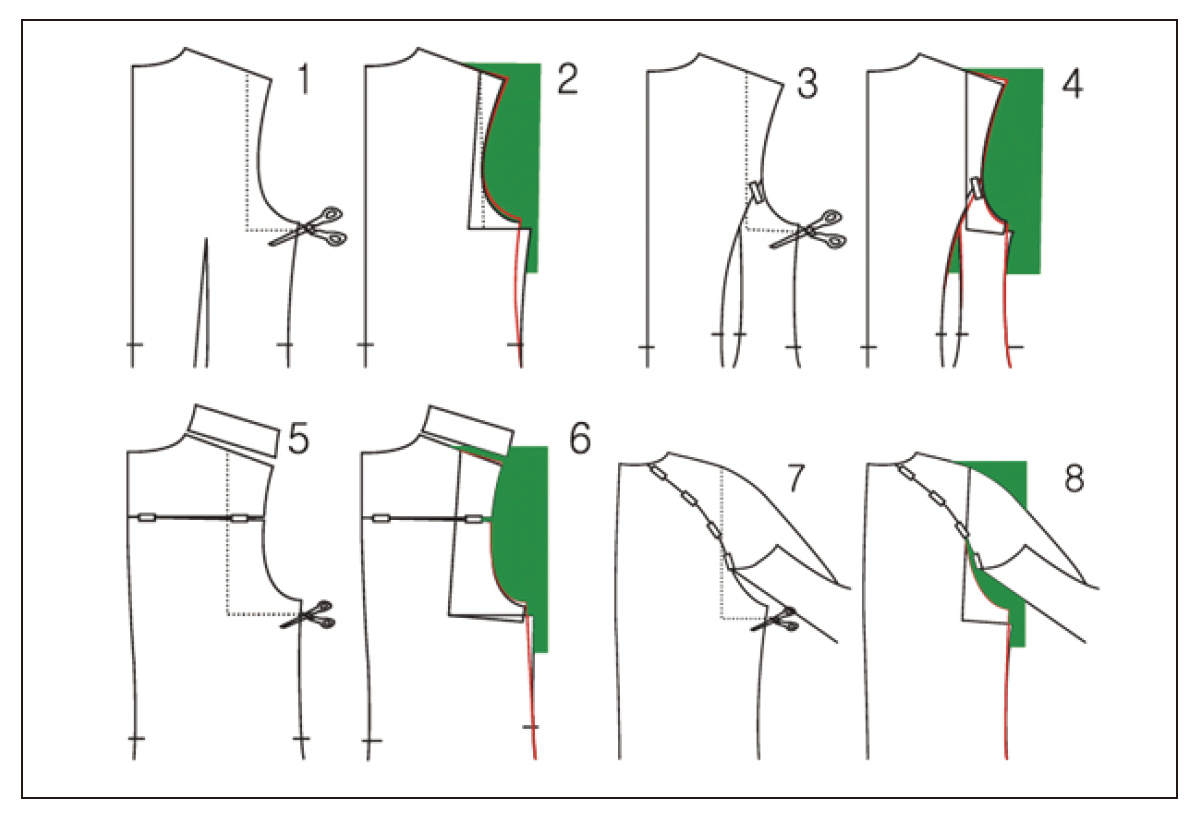
For the back panel without a design line, draw a cut line about 3 cm down from the armpit point along the side seam as in <Figure 1>. Cut the cut line in <Figure 1> leaving a little bit of the end based on the shoulder seam line point, overlap the cut part as in <Figure 2> and reduce it, then go in from the armpit point by the amount of overlap and connect it to the waist point to modify the side seam line. Draw it again by naturally extending the shoulder line and raise the armhole point to match the armhole circumference.
For the back panel with a princess line, align the starting point of the front and side panels on the armhole line as shown in <Figure 3>, attach the tape, and draw the cut line in the same way as in <Figure 1>. Reduce the remaining amount of the back panel by overlapping it as shown in <Figure 2>, and then modify the side seam line by going in from the armpit point to the waist point by the amount of overlap. Extend the shoulder line and draw it naturally again, and naturally modify the princess line as shown in <Figure 4>, and then separate the pattern again.
For the back panel with a yoke on the shoulder, draw the shoulder seam line on the yoke area as shown in <Figure 5>, then cut the shoulder seam line to separate the front shoulder yoke. Attach the remaining back panel yoke line to the yoke suture line of the back body panel and draw an incision line as shown in <Figure 1>. As shown in <Figure 2>, overlap the remaining amount of the back panel to reduce it, then connect the waist point from the armpit point by the amount of overlap to modify the side seam line. As shown in <Figure 6>, extend the shoulder line, organize the armhole line, separate the back yoke line, align the shoulder seam line, and attach the front yoke to connect the armhole line.
For the back panel with raglan sleeves, attach the back panel raglan sleeve to the raglan line of the back panel up to the point where the body and sleeve intersect, then draw a cut line as in <Figure 7>. As in <Figure 2>, overlap the remaining amount of the back panel and reduce it, then connect the waist point to the armpit point by the amount of overlap to modify the side seam line, and then modify the raglan line as in <Figure 8> and remove the sleeve.
Tip
The pattern size of upper garments such as shirts, blouses, and dresses is determined by chest circumference (Women: Bust Cir./Men: Chest Cir.).
The shape and proportion of each human body are different, so the back is narrower than the chest area, so when wearing ready-made clothes for a standard body type, there is excess space in the back.
After placing a hard plate on the armpit area, measure the length between them from the back plate. This measurement is the armpit back wall folding point length suggested by Size Korea. If your measurement is narrow compared to the armpit back wall folding point length of the detailed human body size by name suggested in the <Appendix>
You can improve the fit by modifying the pattern with reference to the difference dimensions.